Affiliate links: if you buy through links on this page we may earn a commission, at no extra cost to you.
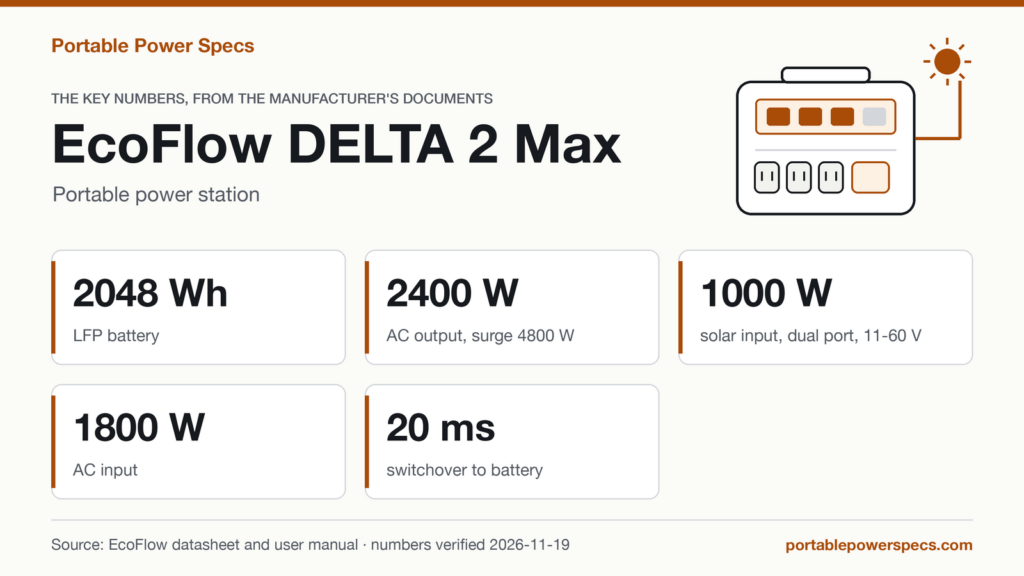
EcoFlow DELTA 2 Max: the solar input numbers, verified
Verified against the manufacturer’s US manual, file dated 2025-07-30 (opens in a new tab) (the PDF prints no version number, so this is the file’s last-modified date) and against the Specs table on EcoFlow’s US product page (opens in a new tab) (read 2026-11-19), on . The figures are for the 120 V edition (AC output voltage, per EcoFlow’s V1.0 manual (opens in a new tab), 2023-05-18).
| Spec | Value | Source |
|---|---|---|
| Battery capacity | 2,048 Wh | Manual 2025-07-30, PDF p. 12 |
| Solar input, as printed | 11-60V 15A, single port 500W; dual port 1,000W | Manual 2025-07-30, PDF p. 13; same line in the Specs table |
| Solar input, voltage window | 11 V to 60 V | Manual 2025-07-30, PDF p. 13 |
| Solar input, current | 15 A, printed once (per port or in total: not stated) | Manual 2025-07-30, PDF p. 13 |
| Solar input, power | 500 W with a single port; 1,000 W with dual ports | Manual 2025-07-30, PDF p. 13 |
| Solar inputs, number | 2 | Manual 2025-07-30, PDF p. 13 (“Solar charging input (×2)”) |
| Solar input connector | Not named for the port. The manual names a cable: Solar to XT60/XT60i Charging Cable | Manual 2025-07-30, PDF p. 8 |
| AC charging input | X-Stream, 1,800 W max | Manual 2025-07-30, PDF p. 12 |
| Car charging input | Supports 12V/24V battery, default 8A | Manual 2025-07-30, PDF p. 13 |
Which unit this page covers: the 2,048 Wh model, EFD350, per EcoFlow’s manuals.
If these solar numbers fit the panels you have in mind, this is where to look for the EcoFlow DELTA 2 Max.
What the numbers mean
Power: one printed line, two ceilings
EcoFlow’s manual states “single port 500W; dual port 1,000W” for solar charging, and the Specs table on the US product page prints the same two figures. That means the unit lists a different ceiling for one input than for two: 500 W with one port and 1,000 W with both. We do not add the ports up: the manual prints the 1,000 W itself.
For scale, the manual lists 1,800 W max for AC charging, so the dual-port solar figure is 800 W below it (1,800 minus 1,000). The solar line reads the same in four EcoFlow documents: the V1.0 manual (2023-05-18), the US manuals of 2024-01-02 and 2025-07-30, and the Specs table read on 2026-11-19.
Voltage window, 11 V to 60 V
The manual states a window of 11 V to 60 V and says to make sure the solar panel’s output voltage is within 60 V to avoid product damage (PDF p. 8). That means the upper end is a rule about the panel you plug in, not only a spec line. The manual does not define “output voltage”; reading it against a panel label is covered on our EcoFlow DELTA 2 solar input page, which has the same 60 V rule.
Current, 15 A: printed once, for which port?
The manual prints 15 A once, inside the solar line, and does not say whether that is for each port or for the two together. EcoFlow’s blog table of 2025-05-09 writes “11-60V, 15A, 500W Max per port, 1000W Max in total”: there “per port” follows the 500 W, and the 15 A is still printed once. No document we read assigns the 15 A to a port or to the total, so this page does not either. That means a layout that depends on the current into one port is not settled by the printed numbers; that question goes to EcoFlow.
Ports and cable: what is listed and what is not
The manual lists the solar input as “×2”: 2 inputs. The connector of those inputs is not named in the documents we read. The manual names a cable, the Solar to XT60/XT60i Charging Cable, and says that cable and Solar panels are not included in the package (PDF p. 8). “XT60/XT60i” is therefore the name of a cable that is not included, not of the port; the 2023 and 2024 manuals call it the “MC4-XT60 adapter cable”. That means matching a panel is a check on the panel’s side, against the cable EcoFlow names: the documents we read do not list panel connectors.
Panel labels set against the 1,000 W figure
EcoFlow’s blog table of 2025-05-09 lists seven panels for this unit, each in a range of counts (see Compatibility). Multiplying each panel’s label power by the highest count listed gives 880 W at most (8 × 110 W and 4 × 220 W), 800 W for the 400 W and 100 W panels and 640 W for the 160 W. The highest total, 880 W, is below the dual-port figure of 1,000 W. This is our arithmetic on the table, not an EcoFlow statement. A label power is a rating, not what a panel delivers, and this page does not estimate output.
Where EcoFlow’s own documents disagree
These three items are not solar input numbers, but each has more than one printed value, so each is shown with the date of its document. This page does not choose between them.
Battery cycles. The US manual file dated 2025-07-30 states 4000 cycles to 80% + capacity. The US manual dated 2024-01-02, the V1.0 manual (2023-05-18) and the Specs table read on 2026-11-19 state 3000 (the table writes “80+%”). Cycles are not turned into years.
UPS switchover. The manuals dated 2025-07-30 and 2024-01-02 say the unit can switch to battery-powered supply in a sudden blackout “within 20ms”; the V1.0 manual (2023-05-18) said “within 30ms”. All of them say the unit does not support 0 ms switching.
X-Boost and surge. The manuals and the Specs table print the AC output as 2,400 W total with a surge of 4,800 W, and, on a separate row, a Max X-Boost Output Power of 3,400 W for the US and Canada. They are two different figures. EcoFlow’s DELTA 2 Max FAQ blog (opens in a new tab) of 2025-07-22 uses the word “surge” for the X-Boost figure (“3.4kW surge”); the manuals do not.
How this differs from the DELTA 2 page
The DELTA 2 is a different unit with its own page. What is specific to the DELTA 2 Max, and not on the DELTA 2 solar input page, is the pair of figures printed for two inputs: the DELTA 2 manual shows a single “Solar/car charging input port”, shared with car charging, and one solar figure.
This page gives no charging time, for solar or for AC: the hours in EcoFlow’s blog table are not used, and the one AC time the manual prints has no start level or test condition.
What it can and can’t do
It can
- Be recharged from solar input (single port 500 W, dual port 1,000 W, as printed), from AC (X-Stream, 1,800 W max in the US and Canada) or from a car charger (12V/24V battery), per the manual.
- Take solar input in a window of 11 V to 60 V on 2 inputs, per the manual.
It can’t
- Take a solar panel whose output voltage is above 60 V, per the manual.
- Come with solar panels or the Solar to XT60/XT60i Charging Cable in the package, per the manual.
Compatibility
| Item | Verification level | Source |
|---|---|---|
| EcoFlow Solar to XT60/XT60i Charging Cable | manufacturer | Manual 2025-07-30 (opens in a new tab), PDF p. 8 (a cable, not a panel) |
| EcoFlow 110W Portable Solar Panel | manufacturer | EcoFlow blog table, 2025-05-09 (opens in a new tab): listed with 2 to 8 panels; 7 panels marked “Not Advised” |
| EcoFlow 160W Portable Solar Panel | manufacturer | EcoFlow blog table, 2025-05-09 (opens in a new tab): listed with 1 to 4 panels |
| EcoFlow 220W Portable Solar Panel (Bifacial) | manufacturer | EcoFlow blog table, 2025-05-09 (opens in a new tab): listed with 1 to 4 panels |
| EcoFlow 400W Portable Solar Panel | manufacturer | EcoFlow blog table, 2025-05-09 (opens in a new tab): listed with 1 to 2 panels |
| EcoFlow 100W Flexible Solar Panel | manufacturer | EcoFlow blog table, 2025-05-09 (opens in a new tab): listed with 2 to 8 panels; 7 panels marked “Not Advised” |
| EcoFlow 100W Rigid Solar Panel | manufacturer | EcoFlow blog table, 2025-05-09 (opens in a new tab): listed with 2 to 6 and 8 panels (7 not listed) |
| EcoFlow 400W Rigid Solar Panel | manufacturer | EcoFlow blog table, 2025-05-09 (opens in a new tab): listed with 1 to 2 panels |
The seven panel rows come from a table on EcoFlow’s US blog, dated 2025-05-09 and more than 18 months old when we read it. It is a marketing page, not a manual or a formal compatibility list: “manufacturer” means EcoFlow names the pair on its own page. We found no panel named in the manuals, so a panel missing from this table is not “unsupported”: EcoFlow does not name it in the documents we read.
Known issues and recall check
We have no known-issue entries on file for this model.
Recall check
For the EcoFlow DELTA 2 Max (model EFD350): no recall found in the CPSC recall database (opens in a new tab) and Health Canada’s recall search (opens in a new tab) on . It is the result of a search on that date, not an assessment of the product.
On that date the only EcoFlow recall in those two sources, dated 2025-10-09 (CPSC) and 2025-10-24 (Health Canada), was for a different product with a similar name, the DELTA Max 2000, model EFD310 (CPSC notice (opens in a new tab), Health Canada notice (opens in a new tab)). EcoFlow’s own notice (opens in a new tab) names model EFD310. The model on this page is EFD350.
What to buy with it
EcoFlow DELTA 2 Max: See the EcoFlow DELTA 2 Max listing (opens in a new tab)
Check the model name (EFD350), the 2,048 Wh capacity and what the listing includes before you buy; this page covers the power station itself.
- Solar panel: the manual says panels are not in the package and that the panel’s output voltage must be within 60 V.
- Solar to XT60/XT60i Charging Cable: named by the manual, not in the package.
- Car charging cable: the manual says to purchase it separately.
FAQ
What are the solar input limits of the EcoFlow DELTA 2 Max?
EcoFlow’s US manual, file dated 2025-07-30, prints 11-60V 15A, single port 500W; dual port 1,000W for its 2 solar inputs.
Is the 15 A per port or for both ports together?
EcoFlow’s documents that we read do not say, and this page does not choose either reading.
Does the EcoFlow DELTA 2 Max come with solar panels or a solar cable?
No: the manual says the Solar to XT60/XT60i Charging Cable and solar panels are not in the package.
How long does the EcoFlow DELTA 2 Max take to charge from solar?
This page gives no charging time. A time depends on the panels, the light and the wiring.
Changelog
- : First published.
Edited by Stefano Mastria. Verified against the manufacturer’s US manual dated 2025-07-30 and the Specs table read on 2026-11-19 (V1.0 manual of 2023-05-18 for the AC output row), on .